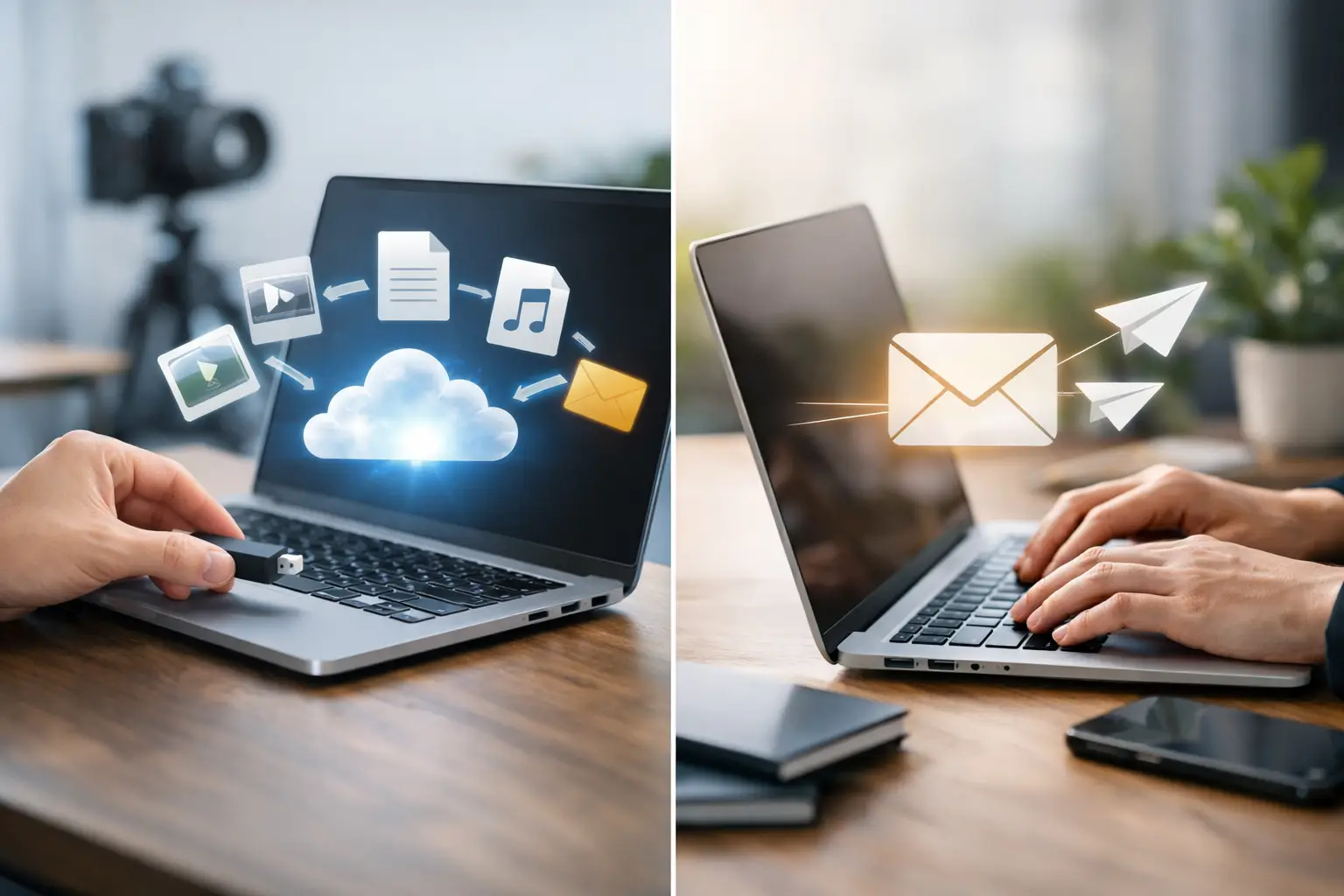
A speaker arrives 12 minutes before doors with a revised deck, an embedded video, and the phrase every speaker room manager knows too well: “I just made a few small changes.” The question is not whether the file can be sent. The question is whether the correct version reaches the correct operator, in the correct room, before the session starts.
That is where event file delivery vs email stops being an IT preference and becomes a show-critical workflow decision. Email is familiar and available. A purpose-built delivery system is designed around rooms, agendas, operators, and the reality that a missed handoff can put the wrong deck on a confidence monitor in front of a full audience.
Why Email Breaks Down During Live Events
Email works reasonably well for advance collection. A speaker submits a deck days before the event, an organizer has time to review it, and the AV team can download and prepare it. The risk increases when email becomes the live delivery channel from the speaker ready room to technical operations.
First, email is not room-aware. An attachment arrives in an inbox, not at a destination tied to Ballroom B, Room 204, or a specific breakout operator. Someone still has to identify the file, determine where it belongs, download it, rename it if necessary, and confirm the handoff. In a multi-room program, every manual step creates another chance for delay or misrouting.
Second, email handles versions poorly under pressure. A subject line such as “FINAL deck v7” does not tell an operator whether it replaces “FINAL deck v6,” whether the embedded video changed, or whether the speaker sent another correction to a different staff member two minutes later. Inbox threads are a record of messages, not a controlled presentation workflow.
Attachment limits create a separate problem. Video-heavy decks, high-resolution slides, fonts, PDFs, and supporting media can exceed mailbox limits or take too long to upload and download. Hotel internet may be congested. Corporate security policies may quarantine attachments. A sender may be on mobile data with an unstable signal. None of this is unusual at a conference.
Email also spreads responsibility across too many people. The speaker assumes the email was received. The ready room assumes it was forwarded. The operator assumes the file in the shared inbox is current. When something goes wrong, there is no clear operational status showing what was delivered, to whom, and when.
Event File Delivery vs Email: The Operational Difference
The core difference is simple. Email moves messages with attachments. Event file delivery moves presentation packages through a defined production route.
A dedicated event delivery workflow starts with the actual roles involved: speaker room staff, technical operators, room assignments, session schedules, and show control. The person receiving materials can select the scheduled session or destination room, send the deck and associated files, and give the receiving operator a clear indication that a new or revised package is available.
That changes the handoff from “I forwarded it” to “The updated keynote is delivered to the Ballroom A operator.” For the AV team, that means less time searching inboxes and shared folders and more time validating playback, checking aspect ratio, confirming fonts, and preparing the show.
The distinction matters most in the last hour before a program starts. At that point, the bottleneck is rarely file transfer alone. It is coordination. Which room needs this? Is this the latest version? Has the operator seen it? Does it include the video file? Is the presenter now asking for a change after the deck was loaded?
A system built for conference operations gives those questions a home. Email leaves teams to answer them through message threads, phone calls, walkie talkies, and memory.
Local LAN Beats Internet Dependency
Many teams try to improve email by adding cloud storage. That can help during pre-production, but it does not remove show-day dependency on internet access, credentials, browser sessions, sync status, or public Wi-Fi.
A local network workflow is different. Files move directly over the venue LAN between the speaker room device and operator machines. The transfer does not require speakers to join a guest wireless network, sign into a cloud account, or wait for an upload to leave the building and come back again through the internet.
For AV teams, this is a practical reliability issue. Venue connectivity can be excellent in a ballroom and weak in a back-of-house room. Guest Wi-Fi can be overloaded during registration. Firewalls can interfere with services no one tested during load-in. A local, offline-capable transfer route keeps the delivery path inside the operation you control.
This does not mean email has no role. Email is still useful for collecting advance materials, sending speaker instructions, and communicating after the event. It is simply a poor substitute for a live production handoff when a session is about to begin.
What a Purpose-Built Workflow Should Handle
Not every file-sharing tool is an event delivery system. A workable conference solution needs to reduce the decisions staff must make at the moment pressure is highest.
At minimum, it should support automatic device discovery on the local LAN, so teams are not spending show morning hunting for IP addresses or setting up complicated network shares. It should route files by room or operator, keep the agenda visible, and make it obvious which session a file belongs to.
It should also support full presentation packages, not just a PowerPoint file. Speakers often bring videos, PDFs, font files, backup slides, and other supporting assets. Separating those items across different emails or folder links creates a predictable failure point when the operator receives the deck but not the media it calls.
Status and communication matter as well. The sender needs confirmation that the operator machine received the material. The operator needs enough context to know whether the incoming file is new, revised, or intended for a future session. If clarification is needed, in-app communication keeps the conversation attached to the operation instead of buried in personal texts and inboxes.
Kondukto is built around that exact handoff: speaker room to technical operator, routed through the local network with room-based delivery and agenda context. No USB, no cloud dependency, and no need to turn an inbox into show control.
The Trade-Offs to Consider
Email is nearly universal. Nobody needs training to attach a file, and teams can use it from anywhere before arriving on site. For a single-room meeting with a small number of presenters and no dedicated AV operation, it may be enough.
A specialized system requires a small amount of event setup. Rooms, operator devices, and the agenda need to be configured. Teams also need to agree that the designated workflow is the source of truth rather than continuing to send files through every available channel. That discipline is a feature, not a burden, but it does require ownership.
The return is most visible when there are multiple rooms, frequent revisions, video content, parallel sessions, or a dedicated speaker ready room. In those environments, even one avoided wrong-version incident can justify replacing an improvised process.
There is also a security and control benefit. Sending presentations through personal email accounts, public transfer services, and random USB drives creates copies that are difficult to track. A local event workflow narrows the path and gives the production team a clearer boundary around where session materials are going.
Build a Handoff That Survives Show Day
The best workflow is not the one with the most features. It is the one your team can follow at 8:42 a.m. when a presenter changes their opening slide, the next session begins in 18 minutes, and three operators are asking for updates at once.
Start by defining one intake point in the speaker room. Assign every presentation to its scheduled room and session before it goes to technical operations. Make the operator destination visible. Treat each late revision as a new controlled delivery, not an email reply that someone may or may not notice. Then verify receipt and allow the operator time to test the actual playback environment.
That process can be supported by email, shared folders, or a dedicated platform, but the tools are not equivalent. Email is built to communicate. Event file delivery is built to get the right show file to the right machine without adding another problem for the crew to solve.
When the room is full and the walk-in music is ending, that difference is not theoretical. It is the difference between asking, “Did anyone get the final deck?” and knowing exactly where it is.